
Rising costs are putting us under real pressure. We shouldn’t have to decide between a meal and paying our monthly energy bill.

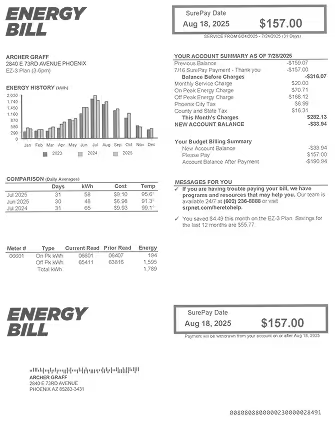
Somewhere between the A/C kicking on and the number at the bottom of that bill, decisions are being made outside of your family.

We’re here to help you Follow the Power and find out who’s actually in charge of your family’s monthly power bill.
Members of the Arizona Corporation Commission (ACC) decide the cost of your utility bill and decide how we meet our future energy needs. The ACC was created to step in and make sure utility companies treat you fairly and serve the public good.
Said another way, the ACC sets the rates you pay, approves infrastructure projects and decides on energy policies that affect Arizona families for decades.
The Arizona Corporation Commission is a government agency. It is comprised of five publicly elected commissioners to oversee monopoly utilities such as APS, TEP and Southwest Gas.
When a utility wants to charge you more, they file something called a rate case with the ACC. Here’s how it works and where your voice fits in.
The utility requests a rate increase and provides their reasoning.
Stakeholders can intervene to provide their analysis. Oftentimes the Residential Utility Consumers Office (RUCO) intervenes and advocates on behalf of residential ratepayers like you.
The public and stakeholders weigh in and share their evaluation and how the request impacts them.
Then the commissioners vote to approve, adjust or deny the rate case.
Public input is important. Real people sharing real stories of hardship and concern show commissioners that we are watching their actions that cost us money.
Wealthy utility companies have armies of lawyers and lobbyists in the decision room.
The ACC approved rate increases of 8% in both 2022 and 2024. Now APS is back, asking for another 14%. That's at least $240 more per year for the average customer. In 2025, APS reported more than $616 million in profits. Their outgoing CEO took home $2.8 million, Their new CEO? $8.4 million.
After the ACC approved a 10% rate increase in 2023, TEP is now requesting another 14% hike, nearly $200 per year for the average customer. TEP reported more than $288 million in profits in 2025. Their parent company, Fortis, made $1.7 billion for its shareholders.
In March 2026, the ACC approved a rate increase of about $5 per month using a new "formula rate" that allows UNS to raise rates annually without a full review process by the ACC. In other states, formula rates have consistently benefited utilities, not customers.
Take a look at where the power has been flowing.


The ACC works for you. Remind the commissioners YOU have the power.
They are elected officials. They answer to you.
Attend an ACC meeting and speak on the record, or just observe. Your presence matters.
Talk to your neighbors. Share your story on social media. The more people who follow the power, the harder it is for the powerful to ignore us.


Submit a public comment
This is the most direct way to put your story on the record. The public can submit comments online, via phone, emails between now and when the hearing ends.
520-628-6550
Provide the docket number for the case or issue you are concerned about:
APS Rate Case: Docket #E-01345A-25-0105
TEP Rate Case: Docket #E-01933A-25-0103